

 Digital dentistry What is a CBCT scan and why your surgeon needs one
How a 3D dental scan works, when it is needed and why it makes implant and oral surgery safer to plan.
Digital dentistry What is a CBCT scan and why your surgeon needs one
How a 3D dental scan works, when it is needed and why it makes implant and oral surgery safer to plan.
Digital dentistry
Guided vs freehand implant surgery: what is the difference?
What is freehand implant surgery?
Freehand implant surgery is the traditional way of placing dental implants. The surgeon studies the X-rays, examines the site, opens the gum and prepares the bone with a sequence of drills. During drilling, the surgeon judges angle and depth by direct vision, anatomical landmarks and measurement. Surgeons have placed many implants successfully this way. In straightforward sites, an experienced surgeon can achieve good results.
The limitation of freehand implant surgery is that the final position depends on what the surgeon can see and feel. Small deviations in angle or depth are possible. They matter more near a nerve, a sinus or a neighbouring root, or when several implants must line up to support one bridge.
How does guided implant surgery work?
Guided implant surgery starts on the computer rather than in the mouth. First, the team combines a CBCT scan of the jaw with a digital scan of the teeth. Then, using planning software, the surgeon places virtual implants in the ideal position for both the bone and the final tooth. The software also shows the distances from nerves, sinuses and adjacent roots in three dimensions.
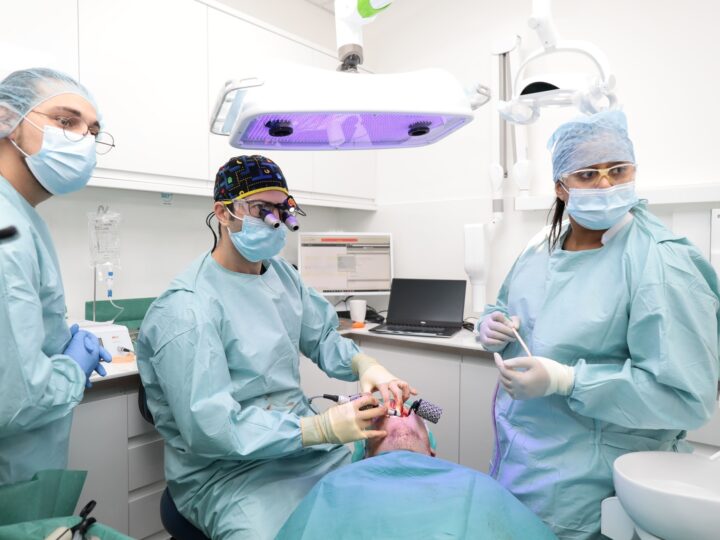
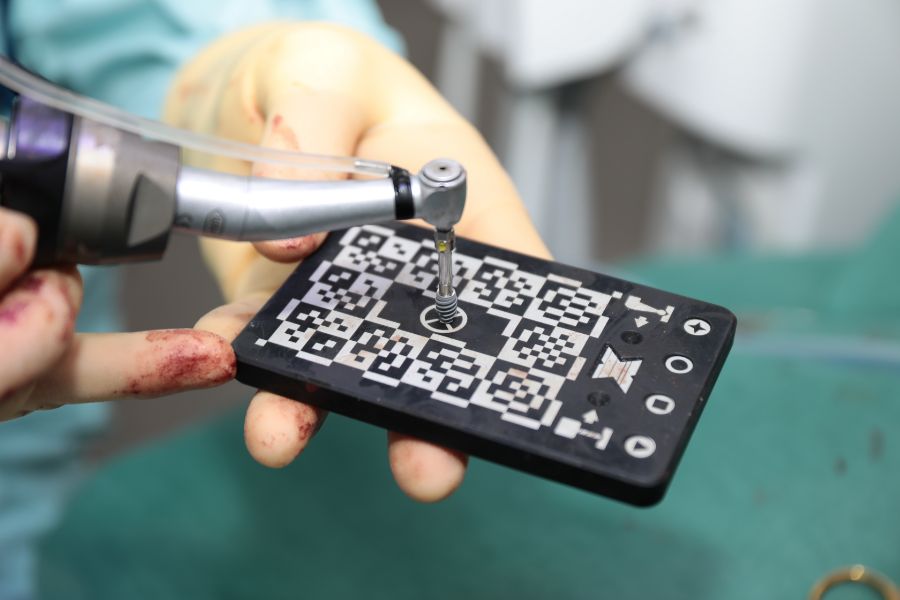
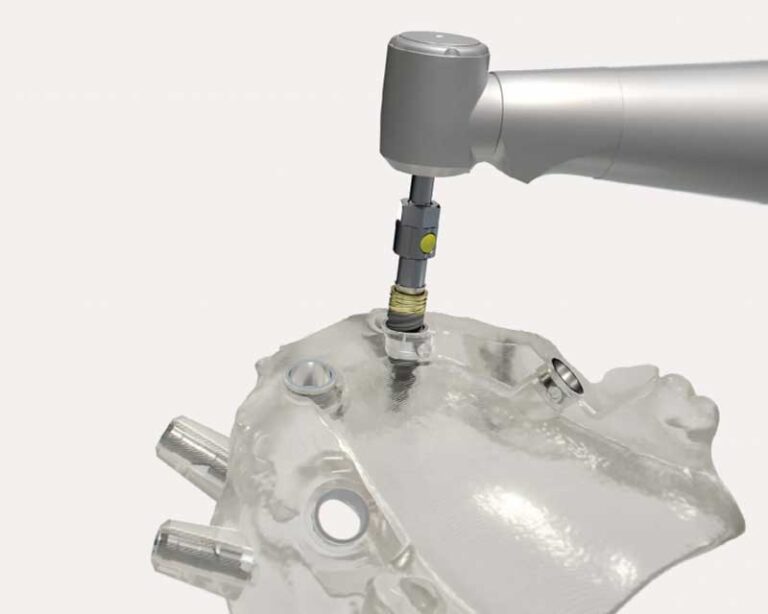
The surgeon then transfers the plan to the mouth in one of two ways. Static guidance uses a surgical guide: a custom 3D-printed template that fits over the teeth or gum. Sleeves in the template direct the drills. Dynamic navigation uses tracking cameras and software to show the drill position on a screen in real time against the plan.
How do static guides and dynamic navigation compare with freehand surgery?
Both forms of guidance aim to reproduce the digital plan accurately. They suit slightly different situations, as summarised below.
| Feature | Freehand | Static guide | Dynamic navigation |
|---|---|---|---|
| Planning | 2D or 3D images, plan in the surgeon’s head | Full 3D digital plan | Full 3D digital plan |
| How the plan reaches the mouth | Surgeon’s judgement | Printed template with drill sleeves | Real-time tracking on a screen |
| Changes during surgery | Easy | Limited, the guide fixes the path | Possible, the surgeon can adjust the plan chairside |
| Mouth opening needed | Normal | Greater, to fit guide and long drills | Normal |
| Typical uses | Simple sites with plenty of bone | Single and multiple implants, full arch | Immediate implants, limited opening, complex anatomy |
For more detail, see the guided implant surgery page for static guides and the X-Guide navigated implant surgery page for dynamic navigation.
Does a guide make placement more accurate than freehand surgery?
Research comparing guided and freehand techniques generally shows that guided surgery reduces deviation between the planned and the actual implant position. Accuracy still depends on the scan quality, the fit of the guide, the calibration of the navigation system and the surgeon’s skill. Guidance is a tool that supports clinical judgement; it does not replace it. Dr Battista is the first author of a published study on dynamic navigation for immediate implant placement in the front of the upper jaw.
Precision has practical consequences. An implant in the planned position is easier to restore with a well-shaped crown. It also keeps a safe distance from nerves and roots and can reduce the need for corrective components later. In full-arch treatment, accurate positioning of several implants helps the bridge fit properly.
Does guided surgery hurt less or heal faster?
In some cases, yes. When bone volume is adequate, your surgeon can sometimes work through a small opening in the gum rather than a full flap. This “flapless” approach usually means less swelling, fewer stitches and a more comfortable first few days.
Not every case is suitable for flapless surgery. If the bone needs grafting, or the surgeon needs to see it directly, the surgeon opens the gum in the conventional way. Even then, the planning stage helps keep surgical time predictable. Your surgeon will explain which approach suits your situation.
When does guidance help most?
Your surgeon can use guidance in most implant cases. However, it adds the most value in these situations:
- implants close to the inferior alveolar nerve in the lower jaw or to the maxillary sinus in the upper jaw
- narrow ridges where there is little margin for error in angle
- front teeth, where the implant position strongly influences the final appearance of the gum and crown
- immediate implants placed into a fresh extraction socket
- multiple implants supporting a bridge, and full-arch treatment such as All-on-4 or All-on-6
- cases where the team prepares a provisional bridge in advance from the digital plan
When might freehand implant surgery still be appropriate?
An experienced surgeon can safely place a single implant freehand in a healed site with generous bone, away from important anatomy. Ideally, a CBCT scan still supports the assessment. Freehand placement also allows flexibility when the bone found at surgery differs from expectations.
In practice, many surgeons use a combination. The team may prepare a full digital plan for every case. Then the surgeon chooses a static guide, navigation or freehand placement according to the site and the patient’s anatomy. Dr Battista routinely uses fully guided and navigated workflows, and he chooses the method case by case.
What does the planning process involve for the patient?
For the patient, guided surgery usually means one extra planning stage before the operation. The typical sequence is:
- Consultation and clinical examination.
- CBCT scan and intraoral scan of the teeth.
- Digital planning of implant positions and, often, the future teeth.
- Design and printing of the surgical guide, or preparation of the navigation plan.
- Surgery, carried out according to the plan.
- Healing, then the final crown or bridge.
The planning stage also gives you a clear picture of the proposed treatment. When you see the implant on screen next to the bone and nerves, it is easier to understand whether you need grafting.
Are there any downsides to guided surgery?
Guided surgery adds a planning step and specialist software, so it can add to the cost and the time before surgery. Static guides need enough mouth opening at the back of the mouth to accommodate the guide and longer drills. A guide that does not seat perfectly can transfer an error rather than prevent one. For this reason, careful checking during surgery is essential.
Dynamic navigation requires specific training and calibration. The surgeon also watches a screen while drilling, which is a different skill from conventional surgery. Neither form of guidance eliminates the normal risks of implant surgery, such as infection, bleeding, nerve disturbance or implant failure, although good planning aims to reduce them.
Does guided surgery affect the final teeth?
Clinicians often call guided surgery “restoration-driven” or “prosthetically driven” planning. Instead of placing the implant wherever the bone happens to be, the surgeon first designs the future tooth on screen. Then the implant goes underneath it. The aim is a crown that emerges naturally from the gum, with the screw access hole in a sensible position. The result should also be easy to clean and maintain.
With this kind of planning, the restorative dentist or laboratory receives a predictable starting point. Crowns can often use a screw fixing rather than cement, which avoids leaving cement under the gum and makes future maintenance simpler. In full-arch cases, the team can also prepare a provisional bridge in advance and fit it on the day of surgery. This works because the implant positions are clear before the operation begins.
Does guided surgery take longer on the day?
The surgical appointment itself is often shorter and more predictable with guidance. Your surgeon has already made many decisions at the planning stage. For example, the surgeon chooses implant sizes in advance and sets the drilling sequence, so there is no measuring and re-measuring during the operation. The overall timeline, however, includes a planning phase of days or weeks before surgery. During that time the team finalises the plan and makes any guide.
For patients who are anxious about long procedures, the reduced chair time can be a meaningful benefit. It can also make treatment under local anaesthetic, with or without sedation, more comfortable.
How do you decide which approach is right for you?
The right approach depends on your anatomy and the number of implants. It also depends on whether teeth need removing on the same day and on the final restoration. A CBCT-based assessment answers most of these questions, including whether freehand implant surgery or a guided approach suits you. If you would like your case assessed in London, you can arrange a consultation and discuss the options in detail.
Frequently asked questions
Is guided implant surgery always better than freehand?
Not always. Guided surgery improves precision and is especially useful near nerves and sinuses, in front teeth and in full-arch treatment. A simple single implant in plenty of bone can be placed safely freehand by an experienced surgeon. Most important is a proper 3D assessment beforehand, and a surgeon who chooses the method to suit the site.
What is a surgical guide made of?
A static surgical guide is usually a rigid, biocompatible resin template produced on a 3D printer from the digital plan. It fits over the remaining teeth, the gum or the bone, and contains metal or resin sleeves that control the position, angle and depth of the drills. It is made for one patient and one procedure.
What is dynamic navigation in implant surgery?
Dynamic navigation uses tracking cameras attached to the patient and to the drill. The software displays the drill position on a screen against the digital plan, in real time, so the surgeon can follow the planned path. It does not need a printed template, and the plan can be adjusted during surgery if the situation requires.
Does guided surgery mean no stitches?
Sometimes. When there is enough bone and gum, guided surgery can be done through a small opening without lifting a flap, so few or no stitches are needed. When grafting is required or the bone must be seen directly, the gum is opened conventionally and stitched. Your surgeon will confirm the approach after reviewing the scan.
Is guided implant surgery suitable for immediate implants?
Guidance can be very helpful for immediate implants, where the implant is placed into a socket on the day a tooth is removed. The socket shape can push the drill off course, and accurate positioning matters for appearance, particularly at the front of the mouth. Both static guides and dynamic navigation are used for this purpose.
More guides
All guides
Digital dentistry What is a CBCT scan and why your surgeon needs one
How a 3D dental scan works, when it is needed and why it makes implant and oral surgery safer to plan.
 Dental implants How much do dental implants cost in London?
The real factors behind implant pricing in London, and how to compare treatment quotes on a like-for-like basis.
Dental implants How much do dental implants cost in London?
The real factors behind implant pricing in London, and how to compare treatment quotes on a like-for-like basis.
 Dental implants Am I a candidate for dental implants?
How bone, gum health, medical history and smoking decide whether dental implants are suitable, and what can improve the odds.
Dental implants Am I a candidate for dental implants?
How bone, gum health, medical history and smoking decide whether dental implants are suitable, and what can improve the odds.
Next step
Talk it through before you decide
Send me a short message about what is going on. You will get an honest answer on whether surgery is the right step, and what the options are.