

Research
Research and teaching
A plain summary of Dr Battista's 2022 navigation study, his case reports, co-authored research and lectures in Naples.
What does my research and teaching focus on?
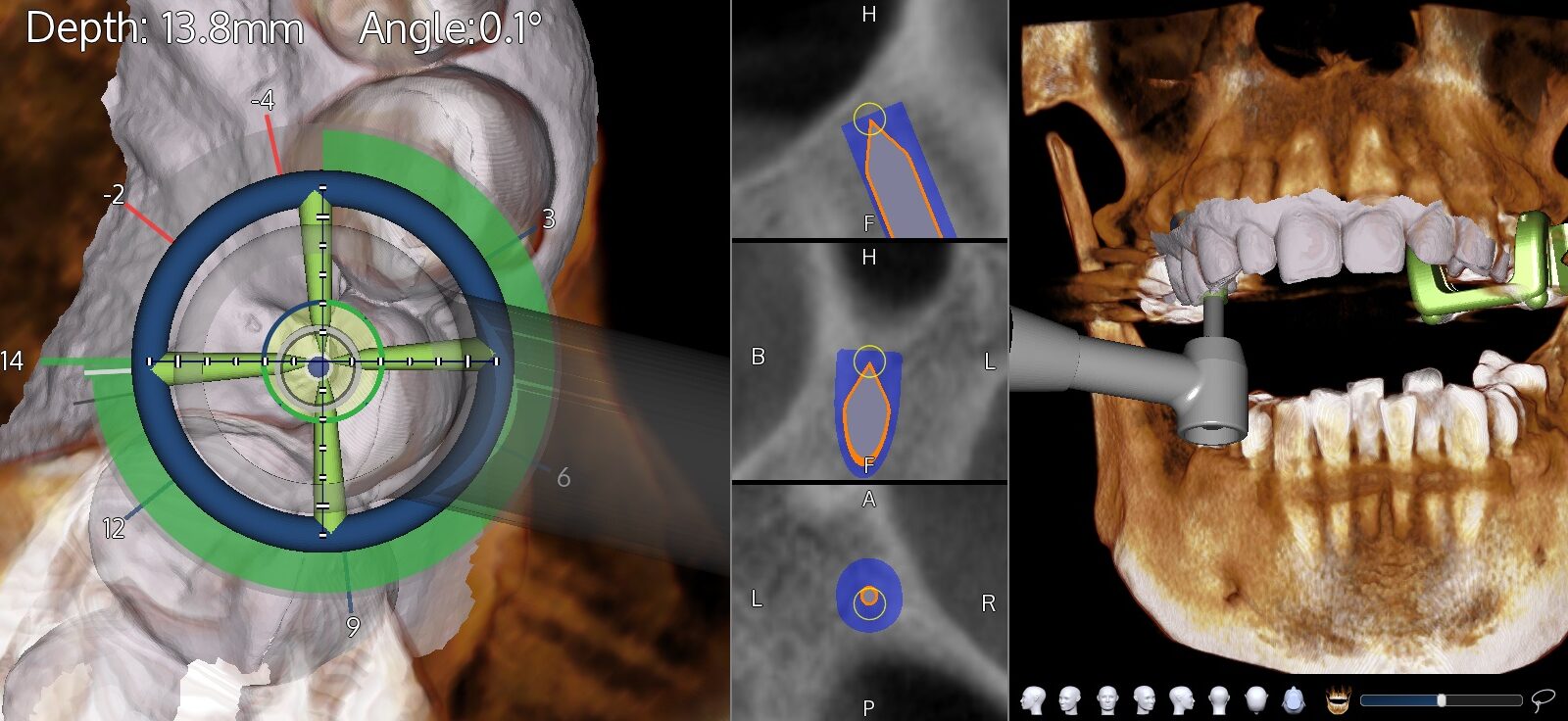
My research and teaching look at computer assisted implant surgery: how accurately a digital plan, built from a CBCT scan and an intraoral scan, can be transferred into the mouth during surgery. In practice, the question matters most in the front of the upper jaw. There, a small error in implant position can affect the gum line and the final appearance of the tooth.
What did the 2022 dynamic navigation study find?
Battista E, Gasparro R, Cacciola M, Sammartino G, Marenzi G. Dynamic Navigation System for Immediate Implant Placement in the Maxillary Aesthetic Region. Applied Sciences 2022; 12(11): 5510. doi:10.3390/app12115510. Notably, Roberta Gasparro and I contributed equally as first authors, and the article is open access.
We ran the study as a retrospective proof of concept at the Department of Oral Surgery of the University of Naples Federico II. It included twelve consecutive adult patients, aged 38 to 55. Each of them needed at least one immediate implant in the aesthetic zone of the upper jaw. In total, we placed 22 implants. By definition, an immediate implant goes into the socket on the same day the surgeon removes the tooth. First, we planned each case in DTX Studio from a CBCT scan and an intraoral scan, starting from the planned crown. Then we placed the implants with X-Guide dynamic navigation, which shows the position of the drill on a screen in real time.
After surgery, we compared a new CBCT scan with the digital plan to measure how far each implant sat from its planned position.
| Measurement | Average deviation from the plan |
|---|---|
| At the implant shoulder (top of the implant) | 0.77 mm (SD 0.25) |
| At the apex (tip of the implant) | 1.2 mm (SD 0.61) |
| Depth | 0.5 mm (SD 0.21) |
| Angle | 2.5 degrees (SD 0.41) |
In addition, nine patients received a temporary tooth on the same day. Over a mean follow-up of six months, however, there were no biological complications and no implant or prosthetic failures.
What are the limits of the study?
However, the study had no control group, a small sample without a formal sample size calculation, and a short follow-up of six months. Overall, within those limits, we concluded that dynamic navigation appeared accurate for prosthetically driven immediate implant placement in the aesthetic zone. We also noted that the technique needs expert surgical skills and a long learning curve, and that further studies are needed. For this reason, the results are an encouraging early finding, not a promise for any individual patient. Meanwhile, you can read how I use the technique on the X-Guide navigated implant surgery and immediate implants pages.
Which case reports belong to my research?
For example, in 2019 I published two case reports in the Journal of Osseointegration (CDUO XXVI proceedings):
- the removal of cysts on both sides of the upper jaw, where I repaired the bone defect with a xenograft (a bone substitute of animal origin), which relates to my bone grafting work;
- a sinus lift through a lateral approach, where I used a surgical guide.
What other research have I contributed to?
During my years in NHS maxillofacial departments, I co-authored Stathopoulos P et al. This review looked at head and neck non-melanoma skin cancer treatment in a skin cancer referral centre. It appeared in Oral Surgery, Oral Medicine, Oral Pathology and Oral Radiology in 2016 (doi:10.1016/j.oooo.2016.10.004).
Where does my teaching take place?
- “The use of DTX Studio and its potential in oral and implant surgery”, Kavo Kerr, Naples, 2019
- “Use of biomaterials in immediate implant placement”, Nobel Biocare and Kavo Kerr, Naples, 2020
In both cases, the talks came from a conviction that also runs through my clinical work. Above all, careful digital planning makes surgery more predictable and easier to explain to patients. So my research and teaching follow the same idea as my surgery. You can read my background on the about page.
Frequently asked questions
Has Dr Battista published research on dynamic navigation?
Yes. Dr Battista is joint first author of 'Dynamic Navigation System for Immediate Implant Placement in the Maxillary Aesthetic Region', published in Applied Sciences in 2022 (doi:10.3390/app12115510). The study measured how closely implants placed with X-Guide navigation matched their digital plan in 12 patients and 22 implants.
Does dynamic navigation guarantee a perfect implant position?
No technique guarantees a perfect result. In Dr Battista's study the average deviation was under one millimetre at the implant shoulder, but the authors stressed the small sample, the short follow-up and the long learning curve. Accuracy also depends on the surgeon's experience, the quality of the scans and the anatomy of each patient.
Where can I read Dr Battista's publications?
The 2022 Applied Sciences article is open access and can be read free through its DOI, 10.3390/app12115510. The 2016 co-authored paper is available through doi:10.1016/j.oooo.2016.10.004. Dr Battista's academic profile is also listed on IRIS, the research repository of Federico II University of Naples.
Next step
Talk it through before you decide
Send me a short message about what is going on. You will get an honest answer on whether surgery is the right step, and what the options are.